Every API through one gateway. Secured, observed, built without code.
An integrated platform for API management, authentication, user access and logging that also streams every database change in real time — cloud-native on Kubernetes and OpenShift, built on open-source Java with no third-party licences to buy.
- Kubernetes / OpenShift native
- Field-level access control
- No-code flow designer
- Log-based change data capture
- English · فارسی · العربية
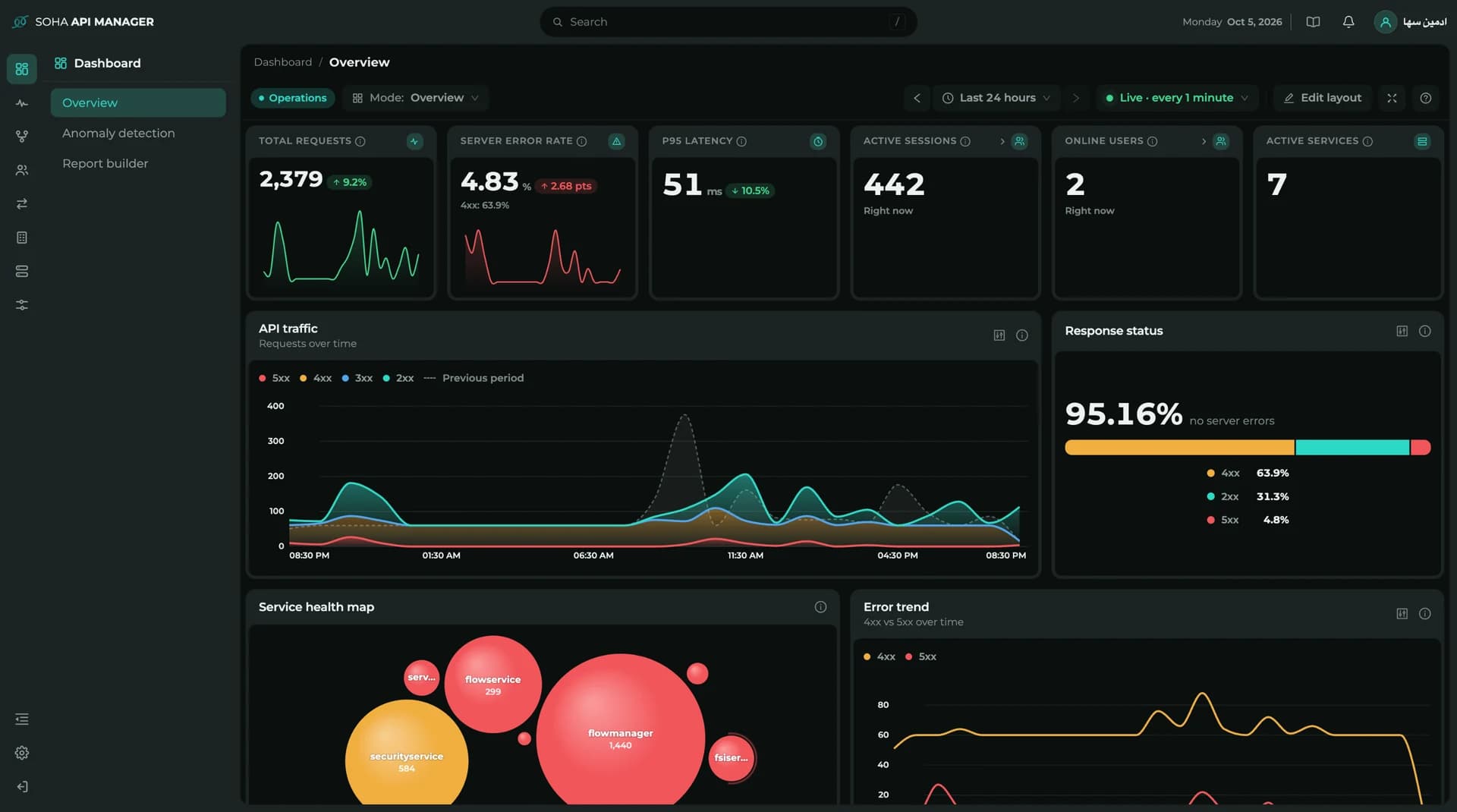
Gateway & flows
Route, compose and publish APIs and database calls on a visual canvas.
Access & security
Roles down to the field, IP allow-lists, rate limits and time windows.
Observability & AI
Live dashboards, self-service reports and ML anomaly detection.
Multi-tenant
One deployment serving many organisations, each fully isolated.
From first API call to production operations, in one panel.
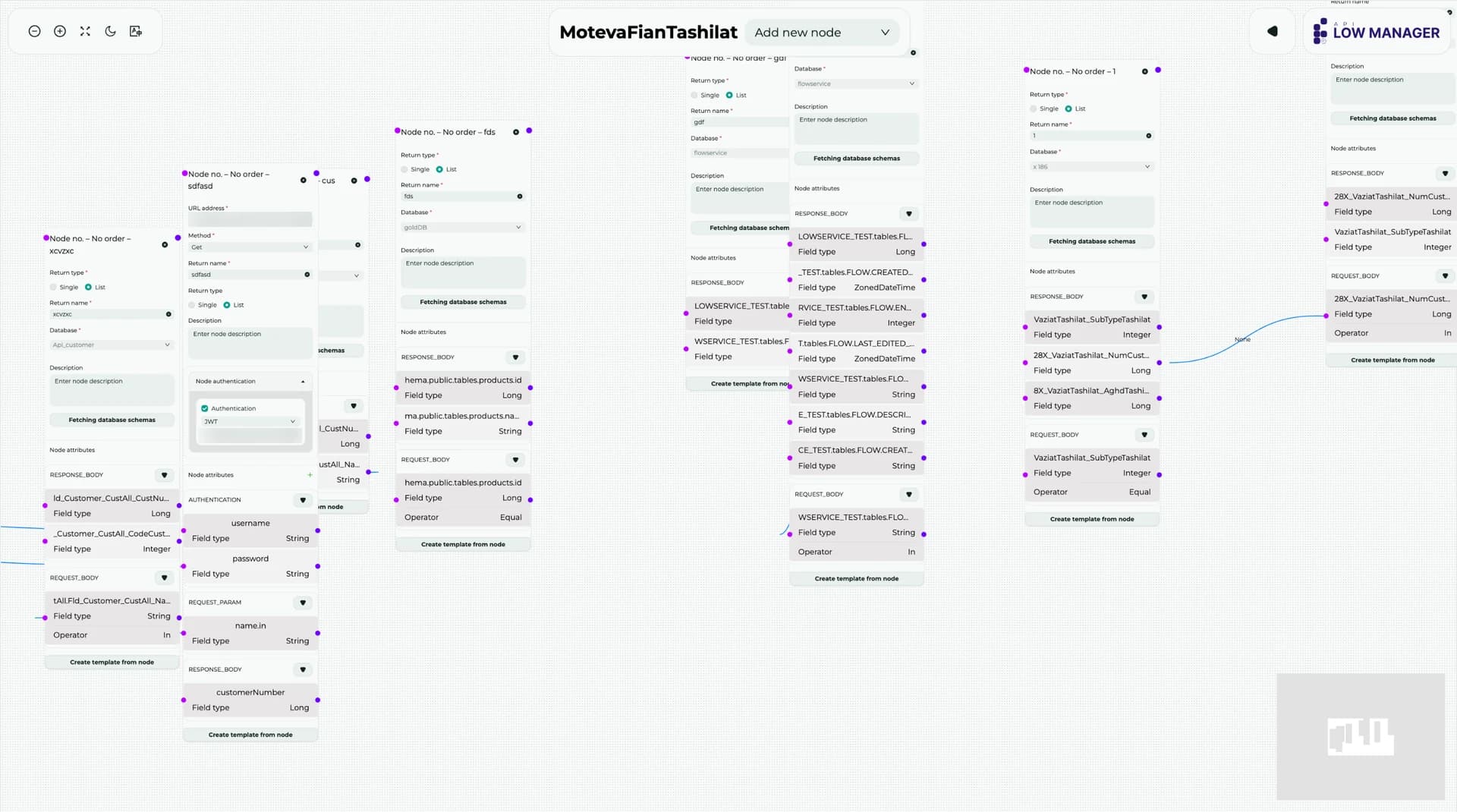
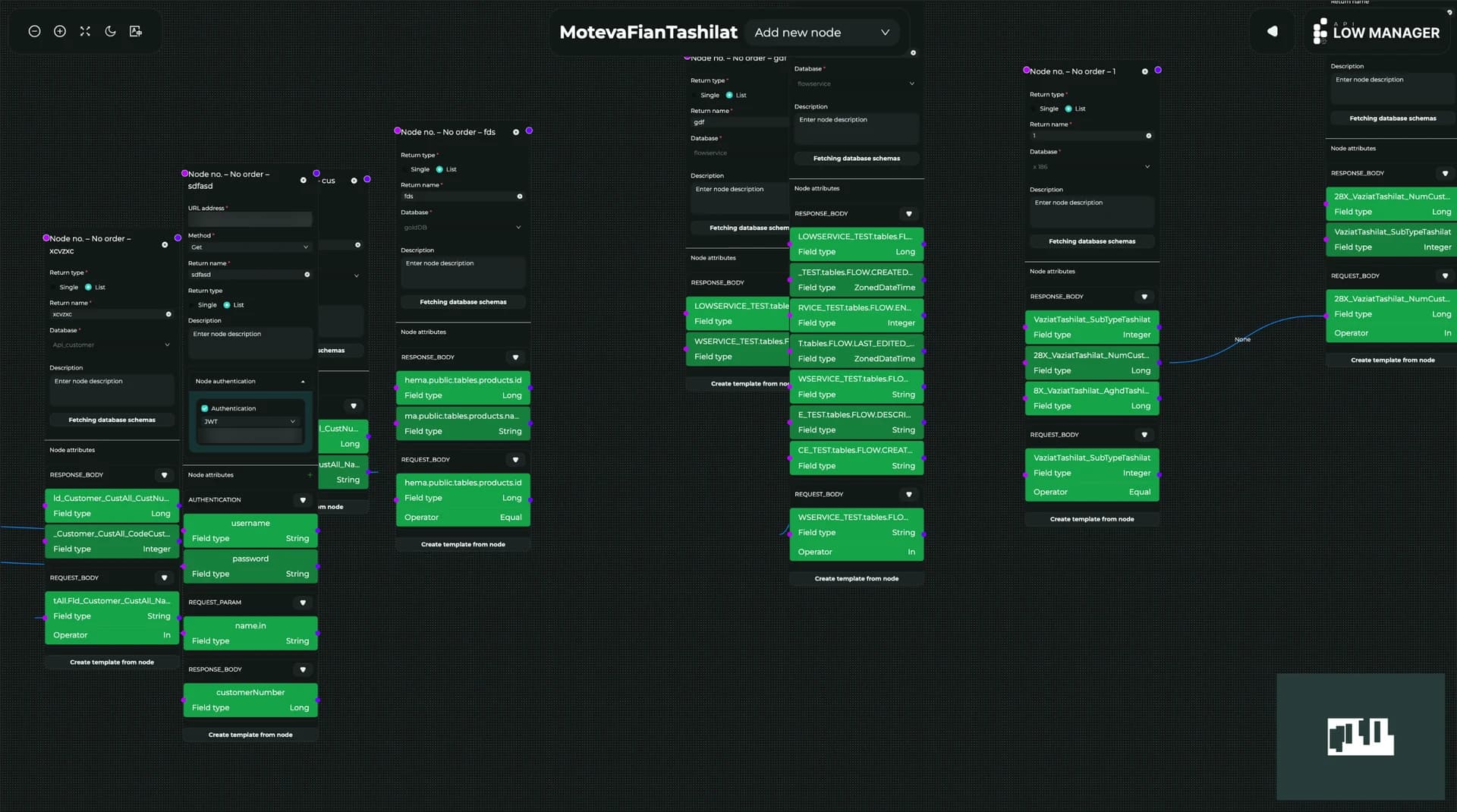
Design integrations visually
Chain API and database nodes on a drag-and-drop canvas, map request and response fields, set authentication per node and publish the result as a new endpoint — without writing code.
- Reuse data from earlier calls in later ones
- API and database nodes in the same flow
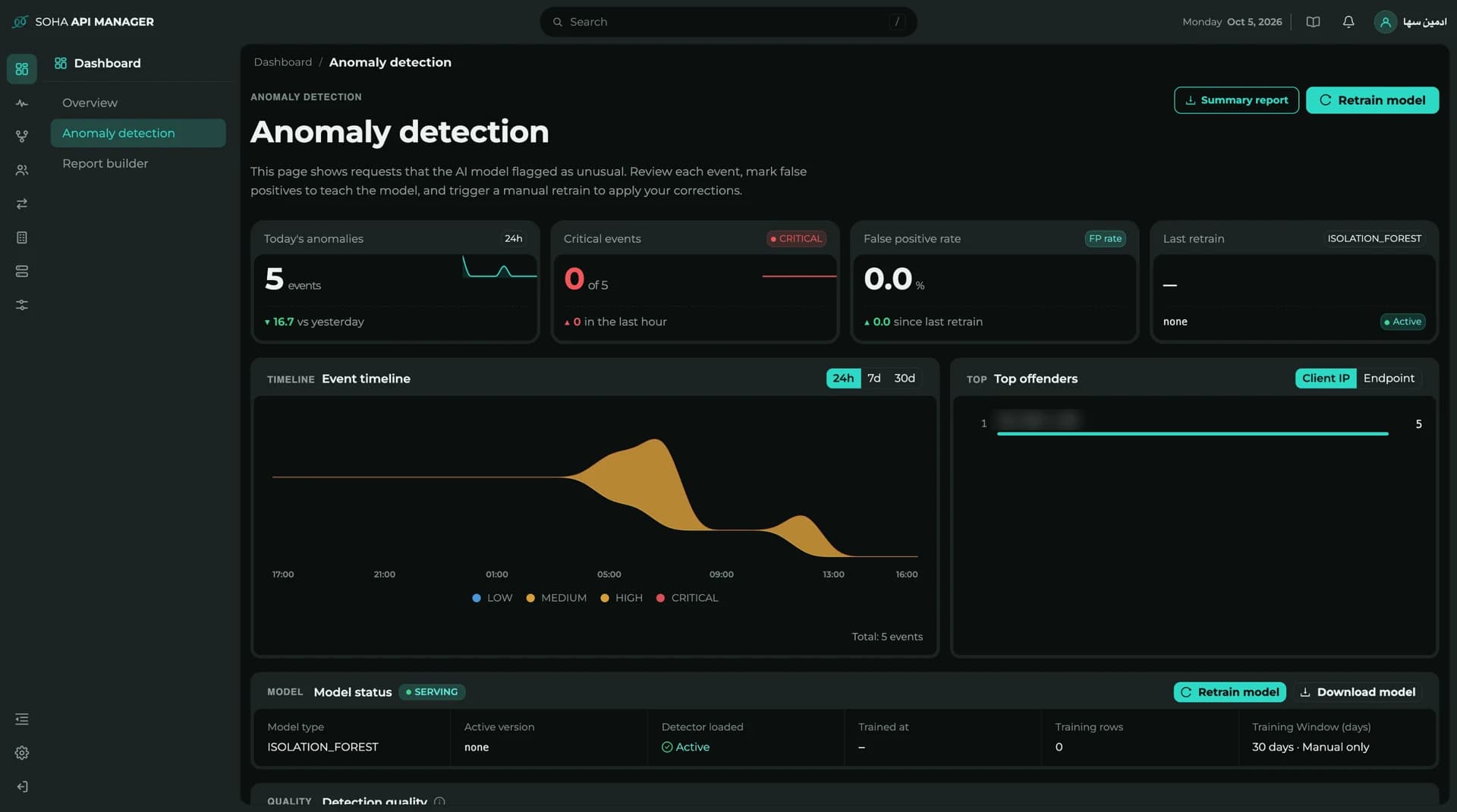
Catch anomalies before they become incidents
A built-in Isolation Forest model watches gateway traffic and ranks unusual requests by severity, with an event timeline and top offenders by client IP or endpoint.
- Mark false positives, retrain on demand
- Severity-ranked, real-time
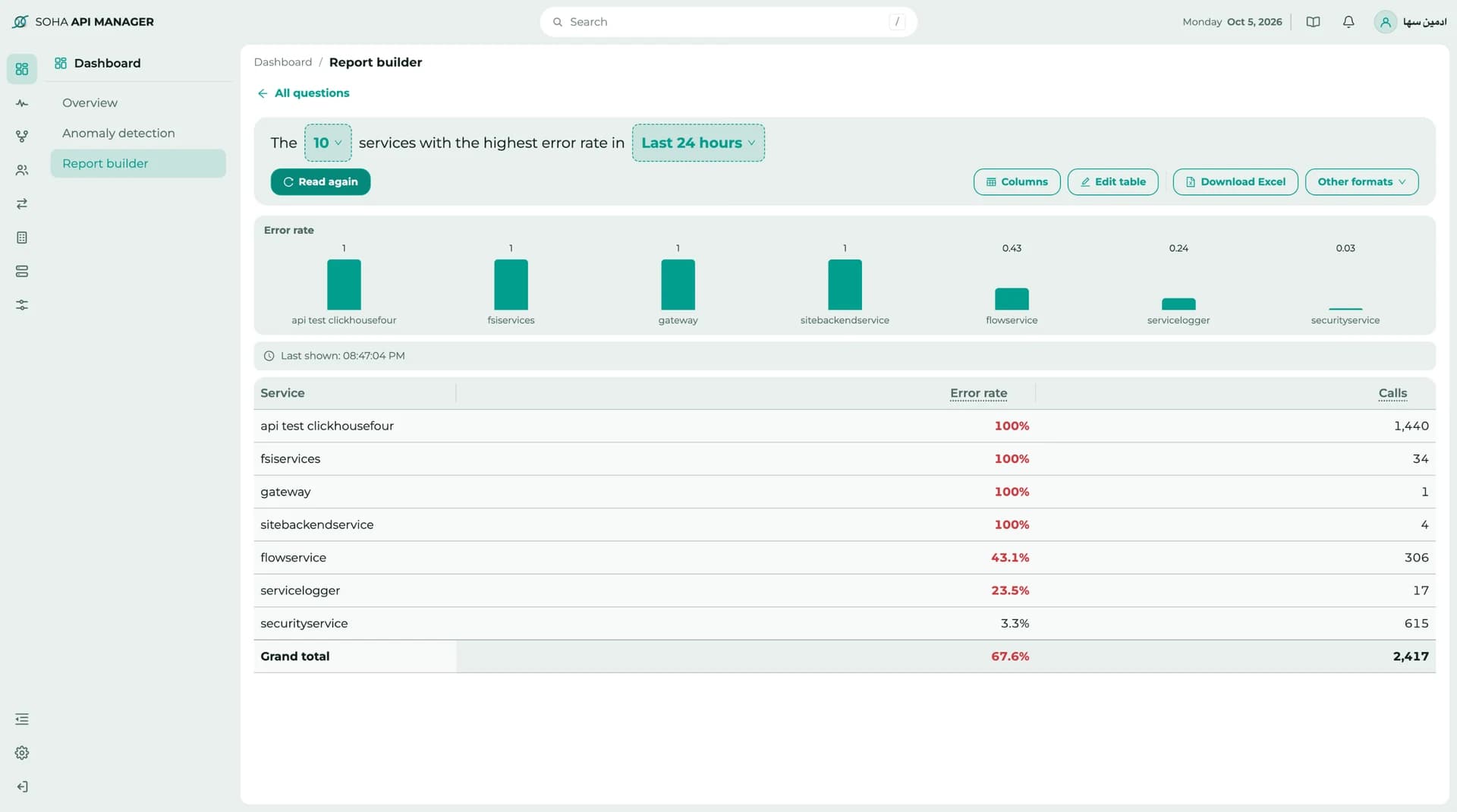
Ask questions, get answers
Build operational reports as fill-in-the-blank sentences — “services with the highest error rate in the last 24 hours” — and get a chart and a table you can customise and export to Excel.
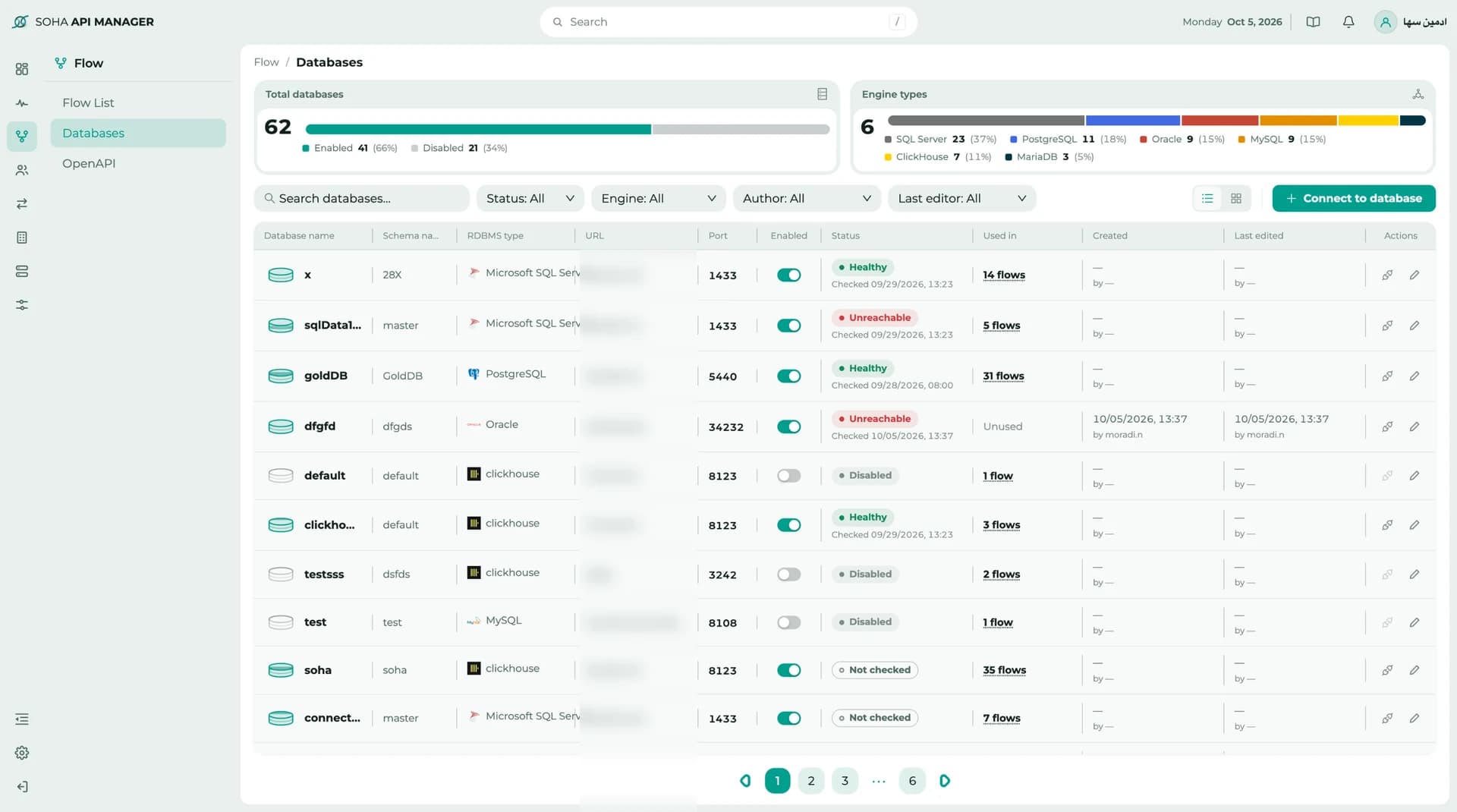
Every database, one place
Connect and health-check your databases, and see exactly which flows use each connection.
- SQL Server
- PostgreSQL
- Oracle
- MySQL
- ClickHouse
- MariaDB
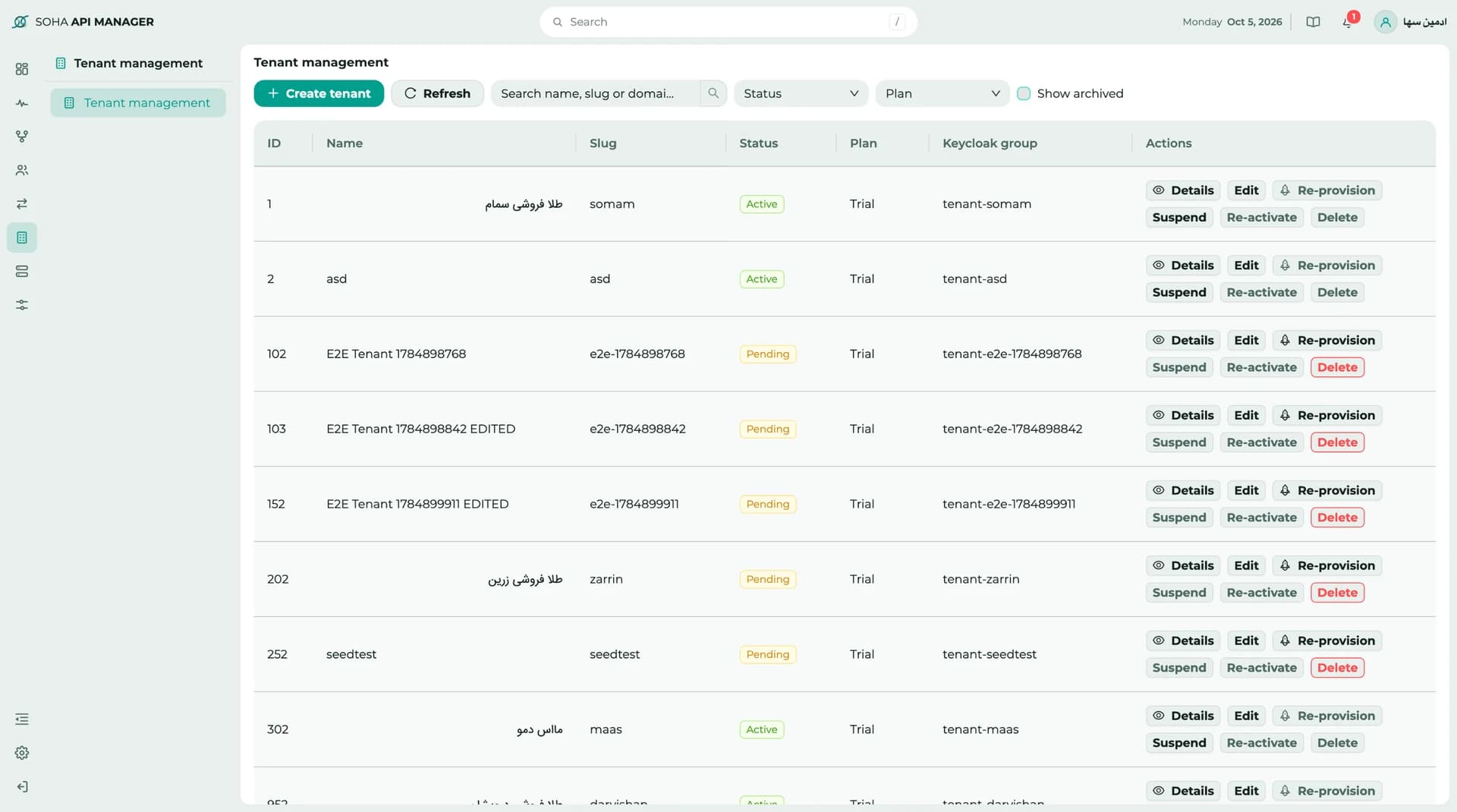
One platform, many tenants
Create, provision, suspend and re-activate tenants. Each gets its own identity group, users, domains and plan.
- Isolated users
- Own domains
- Per-tenant plan
Every database change, streamed the moment it commits.
SOHA CDC reads the transaction log of your core databases and publishes every insert, update and delete as an ordered event stream — no triggers, no polling, no changes to the applications that own the data. The platform that governs your APIs now moves your data too.
- 01
Sources
- Oracle
- PostgreSQL
- SQL Server
- MySQL
- 02
Log-based capture
- Kafka Connect
- 03
Event stream
- Kafka topics · ordered per key
- 04
Consumers
- Secured APIs & webhooks
- Data warehouse & lake
- Search & cache
- Event-driven services
Log-based, zero-intrusion
Reads redo/WAL logs directly. No triggers, no schema changes, minimal load on production.
Ordered & replayable
Events keep commit order per key and can be replayed from any offset to rebuild a downstream system.
Schema-aware
Schema changes are captured and versioned alongside the data, so consumers never break silently.
Governed like your APIs
Same tenants, access control and monitoring as API Manager — publish a change stream as a secured API or webhook.
Everything an API team needs, built in.
Shaped by years of enterprise integration work, drawing on platforms like IBM App Connect and MuleSoft.
Api Management Gateway
The system provides a user-friendly platform for designing workflows, managing APIs, and integrating databases without requiring coding skills. It ensures seamless and flexible performance to meet various business needs.
Cloud-Native Architecture
Built to be cloud-native with a cloud-first strategy, allowing seamless integration with cloud-based tools. Supports automatic installation on Kubernetes/OpenShift with pre-configured features like HPA and load balancing.
User-Friendly Interface
Offers a simple interface for designing and creating flows, enabling users to connect and integrate APIs and databases without coding skills.
Comprehensive API and Database Integration
Supports various databases and data formats, enabling precise flow designs and reusability of previously obtained data in future API calls.
Robust Access Control and Security
Features include user role definitions, field-level access permissions, service call limits, IP-based restrictions, and time-based access controls.
Real-Time Monitoring and Performance Reporting
Provides real-time monitoring of CPU and RAM usage, detailed reporting, and filtering capabilities to ensure efficient operation and scalability.
Live Operations Dashboard
Total requests, server error rate, P95 latency, active sessions and active services at a glance, with API traffic by status class, a service health map and error trends. Refreshes live, supports custom time ranges and a configurable layout.
AI-Powered Anomaly Detection
A built-in machine-learning model (Isolation Forest) flags unusual API requests by severity, with an event timeline and top offenders by client IP or endpoint. Analysts can mark false positives and retrain the model on demand.
Self-Service Report Builder
Ask operational questions as fill-in-the-blank sentences, such as the services with the highest error rate in the last 24 hours, and get a chart plus a table you can customise and export to Excel or other formats.
Database Connection Hub
Connect SQL Server, PostgreSQL, Oracle, MySQL, ClickHouse and MariaDB from one place, monitor each connection's health and see exactly which flows use it.
Multi-Tenant Management
Create, provision, suspend and re-activate tenants from the panel. Each tenant gets its own identity group, users, domains and plan, so one deployment can serve many organisations.
Multilingual, Themeable Interface
English, Persian and Arabic with automatic right-to-left layout, plus light, dark and high-contrast modes and adjustable text size.
See a flow go from canvas to live endpoint.
A walkthrough of the panel: building a flow, securing it and watching it in the dashboard.
Questions, answered.
Something else? Talk to our team.
What is the system designed for?
The system is designed as an integrated solution for API management, user access, authentication, and logging, catering to organizations of all sizes.
How does the system handle cloud integration?
It follows a cloud-first strategy, seamlessly integrating with all cloud-based tools and automating deployment on Kubernetes/OpenShift.
What security features are included?
The platform offers access control down to the field level, user role definitions, IP-based restrictions, and limitations on service calls with rate limits and time ranges.
Can the system handle database integration?
Yes, it supports integration with various databases and data formats, allowing precise flow designs and efficient reusability of data.
Can one installation serve several organisations?
Yes. Built-in multi-tenancy lets you create and provision isolated tenants, each with its own users, domains and identity group, and suspend or re-activate them from the panel.
Does the platform detect unusual API traffic?
Yes. An integrated machine-learning model flags anomalous requests in real time, ranks them by severity and learns from analyst feedback through on-demand retraining.
See it running on your own APIs.
Book a walkthrough with our engineers.